
.png)
.png)
-TOP 3 in the term
-Selected for the ArtCenter Gallery
-Finalist at IDSA Awards 2018
-Featured in Yanko Design
Eyes in the back of your head
Ronin is the helmet that prevents the accidents, by giving extrasensory abilities to the rider. There is an increasing number of riders in American highways who are meeting their demise because of accidents caused by inability to react and predict dire situations. Every experienced rider knows that situational awareness is immensely reduced while riding, due to fatigue, wind noise, and the sheer cognitive load of riding.


PREVENTION vs PROTECTION
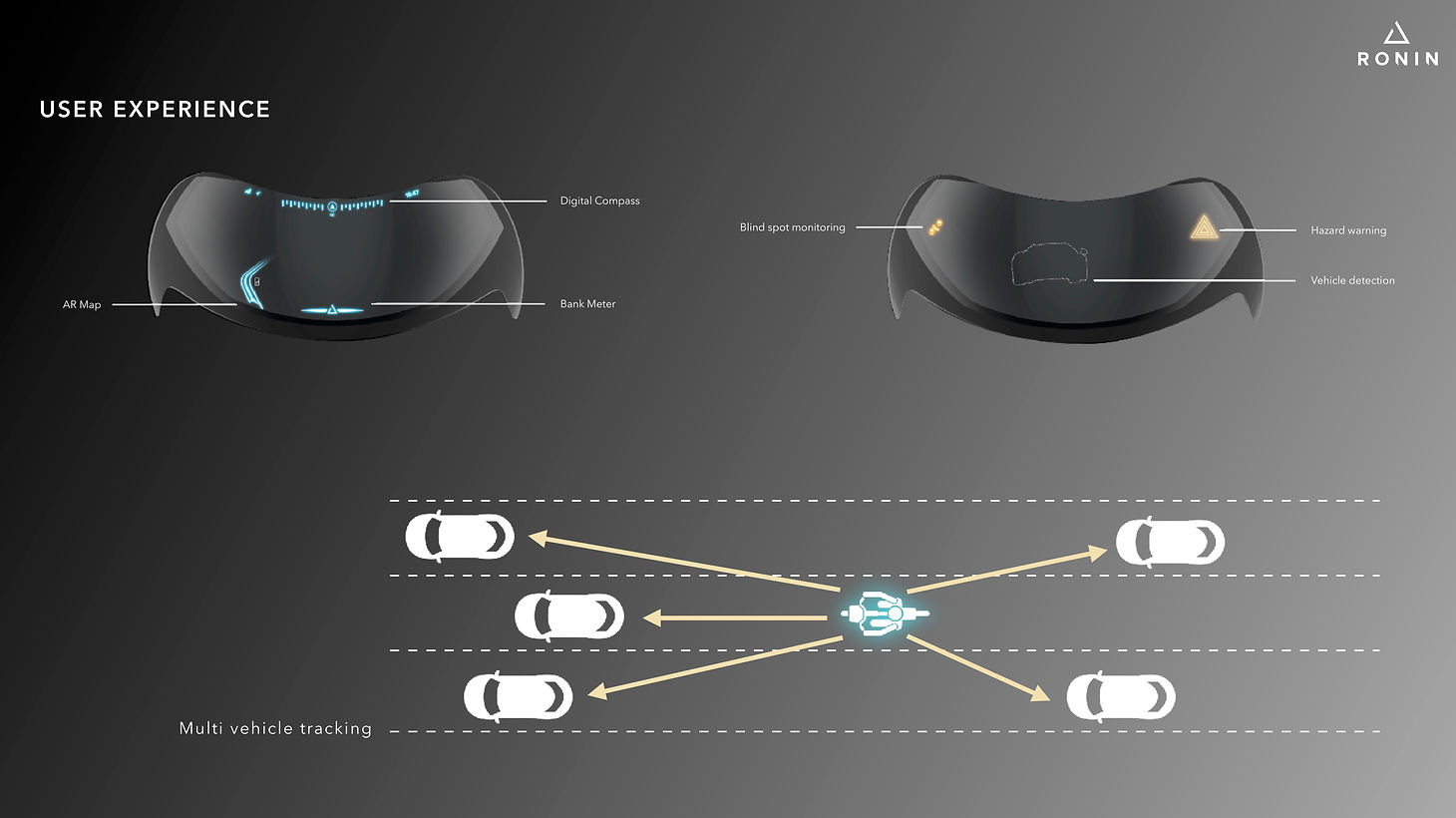
RONIN is designed to be more than a protective solution for the rider. It is designed as a device that senses traffic around the rider and has the ability to visually communicate them to the rider, in an unobtrusive Heads-Up-Display. The helmet connects to the users preferred navigation service and provides turn by turn navigation for the time the user is riding.


Minimal & Functional
The helmet consists of a sensor suit, consisting stereo depth sensing IR cameras, micro radar, and powered by an ARM based processor on-board the helmet for virtually zero lag. The helmet is designed around the user, so the visor retracts into the helmet when not in use, and provides a clean HUD for the rider.


Concept Pitch
A concept pitch video is essentially designed to explain the entire project in a video format making it easier to digest and making it more appealing. It was also used as a presentation tool to communicate the project to a viewer.

RONIN

Context
This conceptual helmet deals with the inherent risks of riding a motorcycle. There is an increasing number of riders in American highways who are meeting their demise because of accidents caused by inability to react and predict dire situations. Every experienced rider knows that situational awareness is immensely reduced while riding, due to fatigue, wind noise, and the sheer cognitive load of riding.
A stat released by NHTSA states that most accidents happen on highways and arterial roads, where relative speeds are higher, and reaction times are shorter. More people are buying personal mobility solutions most of which are motorcycles or motorized scooters. In the motorcycle segment the popularity of tourers are steadily on the rise since the late 2000s.
Since inception bikers in general are the most vulnerable group of individuals. They are exposed to the elements, rain, sun, snow and wind, paired with the hazards of the roads it makes biking one of the most perilous methods of commute. The dangers hasn't stopped people from shunning biking, on the contrary it has developed a cult following and has risen to the status of being a lifestyle.
The motorcycle industry has been flourishing, with state-of-the-art vehicles that are faster and more efficient in every respect. As speeds increased the dangers have multiplied exponentially. The industry has focused on improving the vehicle but development in the user's experience has been slow and stagnant. Services like navigation and blind-spot monitoring have been excluded from the riding experiences till now. The challenge lies in preserving the sheer visceral experience of riding while allowing a safer ride.
Prototyping
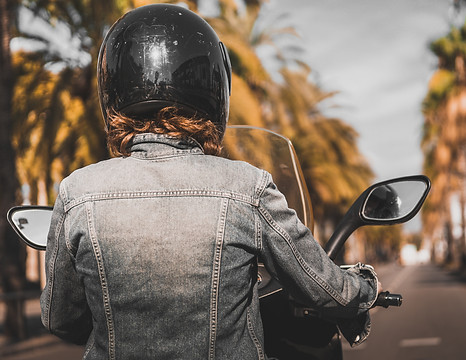
Understanding the target demography played a crucial role in establishing the forms, tech-packaging, CMF, UX and ergonomics. With the help of iterative sketching, model-making, rapid-prototyping it was possible to translate initial concepts into prototypes, that are 1:1 scale, and wearable.


